Complete Firearms Safety Guide for New Owners
You just bought your first firearm. Congratulations! Now the real work begins.
This isn’t just about storing a piece of metal in your closet. You’re holding a tool that demands respect. Every single day. No exceptions.
I’ve been teaching firearm safety for four decades. I’ve seen what happens when people skip the basics. Trust me – you don’t want to learn these lessons the hard way.
This guide will teach you everything you need to know. Safe handling. Proper storage. Legal requirements. And yes, we’ll get you ready for that concealed carry permit if that’s your goal.
Let’s dive in.
The Four Cardinal Gun Safety Rules That Will Save Your Life
Forget everything else for a moment. These four gun safety rules are your lifeline. Master them first.
Rule #1: Every Firearm is Loaded Period. End of story. I don’t care if you just watched someone clear it. I don’t care if you cleared it yourself five minutes ago. Treat it like it has a live round chambered.
This rule eliminates careless handling. It stops the “I thought it was empty” accidents that make the evening news. Gun safety starts with this mindset.
Rule #2: Never Point the Muzzle at Anything You Don’t Want to Destroy Your muzzle is your responsibility. Always. Whether you’re loading, cleaning, or just moving the firearm around your house.
Good muzzle control becomes second nature. Bad muzzle control ends relationships. And lives. This gun safety principle applies everywhere – at home, at the range, in the field.
Rule #3: Finger Off the Trigger Until You’re Ready to Shoot Your finger belongs on the frame. Not the trigger guard. Not hovering over the trigger. On the frame.
Move it to the trigger only when you’ve decided to fire. Not before.
Rule #4: Know Your Target and What’s Beyond It Bullets don’t stop at your target. They keep going. Through walls. Through doors. Into the next room where your family sleeps.
Know what’s behind your target. Every single time.
Why These Rules Work Together
| Rule | What It Prevents | Real-World Example |
|---|---|---|
| Treat as Loaded | Careless handling | “I didn’t know it was loaded” accidents |
| Muzzle Control | Pointing accidents | Sweeping friends at the range |
| Trigger Discipline | Accidental discharge | Finger slips during handling |
| Know Your Target | Overpenetration | Bullets traveling through walls |
These rules create layers of protection. Break one rule, and the others still protect you. Break two rules, and you’re in dangerous territory. Break three or four? You’re asking for trouble.
Learning to Handle Your Firearm Like a Pro
Confidence comes from competence. Competence comes from practice. But first, you need to learn the right way to do things.
Getting Your Stance Right
Two main stances dominate the shooting world:
Isosceles Stance
- Face the target square
- Feet shoulder-width apart
- Equal weight on both feet
- Both arms extended equally
Weaver Stance
- Shooting-side foot back
- Body angled 45 degrees to target
- Strong arm pushes, weak arm pulls
- More aggressive, mobile stance
Which one should you use? Start with isosceles. It’s easier to learn. Once you master it, experiment with Weaver.
Gripping Your Firearm Correctly
Here’s what most beginners get wrong. They grip too low. They use too much shooting hand. They forget about their support hand.
Do this instead:
- High grip with your shooting hand. Get that web between thumb and finger as high as possible on the backstrap.
- Fill the gaps with your support hand. No empty spaces. Your hands should work as one unit.
- 60/40 pressure split. Support hand does most of the gripping. Shooting hand focuses on trigger control.
- Support thumb forward. Point it toward the target, along the frame.
Loading and Unloading Safely
Every firearm type has specific procedures. But the safety principles remain the same.
Semi-Automatic Pistol Loading:
- Point in safe direction
- Insert loaded magazine until it clicks
- Grip the slide firmly
- Pull all the way back
- Release quickly
- You now have a loaded pistol
Semi-Automatic Pistol Unloading:
- Point in safe direction
- Remove magazine first
- Lock slide back
- Visually inspect chamber
- Physically check chamber with finger
- Let slide forward on empty chamber
Pro tip: Always unload magazine first. Otherwise you’ll just chamber another round when you rack the slide.
Clearing Malfunctions Without Panic
Firearms jam. It happens. Don’t panic. Follow these steps.
The Universal Fix: Tap-Rack-Assess
| Step | Action | Why It Works |
|---|---|---|
| Tap | Strike magazine base firmly | Seats loose magazine |
| Rack | Pull slide fully back and release | Ejects stuck case, chambers new round |
| Assess | Check if problem is solved | Determines if ready to fire |
This clears 90% of malfunctions. If it doesn’t work the first time, try once more. Still jammed? Stop shooting and get help.
Common Malfunction Types
Failure to Feed
- Cartridge doesn’t chamber fully
- Usually caused by weak magazine springs or dirty chamber
- Tap-rack-assess fixes most cases
Double Feed
- Two cartridges try to enter chamber
- Requires manual clearing
- Remove magazine, lock slide open, clear both rounds
Stovepipe
- Empty case gets stuck in ejection port
- Looks like a stovepipe sticking up
- Usually clears with tap-rack-assess
Remember: Keep the muzzle pointed in a safe direction during all malfunction clearing. Gun safety doesn’t take breaks during equipment problems.
Storage That Actually Works
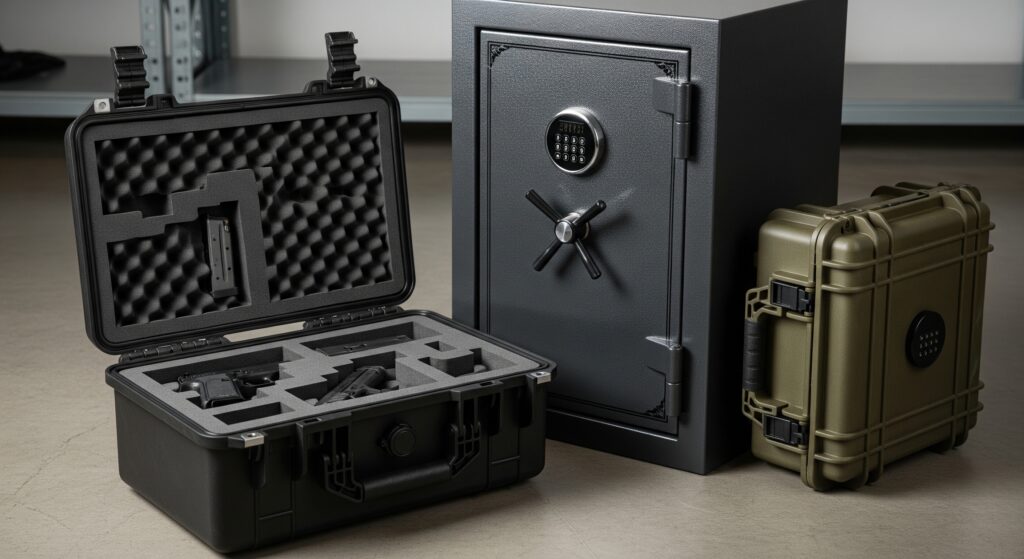
Your firearm isn’t doing anyone any good if a criminal steals it. Or worse – if a child finds it.
Home Storage Options
| Storage Type | Security Level | Access Speed | Best For |
|---|---|---|---|
| Gun Safe | Highest | Slowest | Long-term storage |
| Quick-Access Safe | High | Fast | Bedside defense |
| Cable Lock | Medium | Slow | Temporary security |
| Trigger Lock | Medium | Slow | Transport/storage |
What the Experts Recommend
Primary Storage: Heavy gun safe, bolted to floor Secondary Storage: Quick-access bedside safe Ammunition: Separate locked container
Child-Proofing Your Home
Kids are curious. Kids are clever. Kids will find your firearm if you’re not careful.
Physical barriers work:
- Locked safes
- Cable locks
- Trigger locks
- Separate ammunition storage
Education works too:
- Teach kids firearms aren’t toys
- Use age-appropriate gun safety lessons
- Hide keys and combinations
- Practice “don’t touch, tell an adult”
But never rely on education alone. Physical barriers first. Education as backup.
Transportation Laws That Matter
Moving firearms legally requires understanding the rules. Mess this up, and you could face serious charges.
Federal Transportation Rules
The Firearm Owners Protection Act gives you some protection when traveling between states. But you must follow these rules:
✅ Firearm must be unloaded ✅ Firearm must be in locked container
✅ Ammunition stored separately ✅ Both firearm and ammo inaccessible to passengers ✅ You must be legally allowed to possess the firearm in both origin and destination states
State-by-State Variations
Every state has different rules. Some examples:
| State Type | Rules | Examples |
|---|---|---|
| Constitutional Carry | Few restrictions for residents | Texas, Florida, Ohio |
| Shall Issue | Must issue permits to qualified applicants | Most states |
| May Issue | Permits at discretion of authorities | California, New York |
| No Issue | Extremely difficult to get permits | Hawaii, some cities |
Before you travel: Check the laws in every state you’ll pass through. Not just your destination.
Shooting in Different Environments
Different places have different rules. Here’s what you need to know.
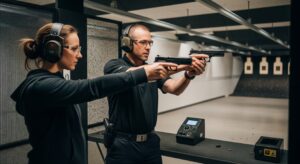
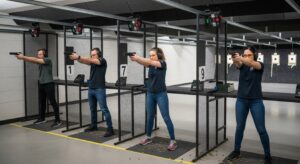
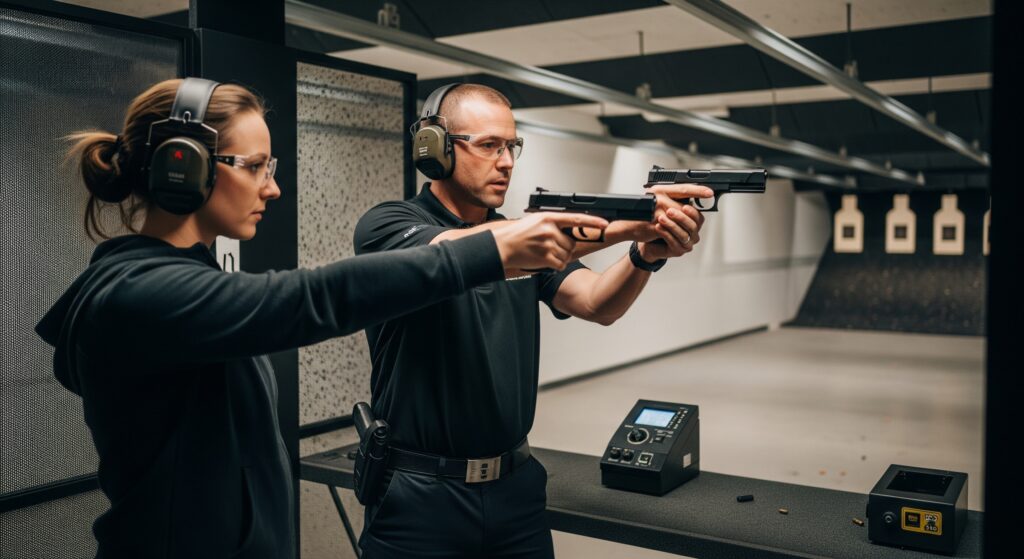
Indoor Range Safety Rules
Indoor ranges are controlled environments. But they have their own hazards. Range safety becomes even more critical in these confined spaces.
Standard Range Safety Rules:
- Eye protection mandatory
- Ear protection mandatory
- Stay in your assigned lane
- Cease fire when commanded
- No handling firearms during cease fire
Less Obvious Range Safety Concerns:
- Lead dust buildup
- Poor ventilation
- Ricochets off concrete
- Noise-induced hearing loss
What to bring:
- Quality eye protection (wrap-around style)
- Electronic ear protection (lets you hear commands)
- First aid kit
- Cell phone for emergencies
Outdoor Range Considerations
Outdoor ranges offer more space and different challenges. Range safety protocols must adapt to these open environments.
Weather affects everything:
- Wind pushes bullets off target
- Rain makes targets hard to see
- Sun glare blinds you
- Cold makes hands stiff
Range safety becomes more complex:
- Natural backstops vary in quality
- Other shooters spread over wider area
- Wildlife might wander onto range
- Emergency help farther away
Hunting Safety Fundamentals
Hunting adds moving targets and other hunters to the equation.
Orange clothing isn’t optional. In most states, it’s the law. Even where it’s not required, wear it anyway.
Communication prevents accidents:
- Plan your hunt together
- Establish shooting zones
- Use radios or cell phones
- Never assume you know where others are
Shot placement ethics:
- Know your effective range
- Practice field shooting positions
- Use appropriate ammunition
- Take only shots you’re confident about
Understanding Firearms Law
Legal gun ownership means staying within the law. Always.
Federal Law Basics
Background Check Requirements:
- All purchases from licensed dealers
- Private sales rules vary by state
- Some exceptions for family transfers
- Concealed carry permits affect requirements
Age Restrictions:
- 18 for long guns (rifles/shotguns)
- 21 for handguns
- Some states have different rules
- Military exceptions apply
Prohibited Persons Cannot Own Firearms:
- Felony convictions
- Domestic violence convictions
- Restraining orders
- Mental health adjudications
- Illegal drug users
State Law Variations
States can add restrictions but cannot remove federal ones.
Common State Requirements:
- Permits to purchase
- Mandatory training courses
- Registration requirements
- Assault weapon bans
- Magazine capacity limits
Concealed Carry Recognition:
| Your State Permit | Recognized In | Not Recognized In |
|---|---|---|
| Florida | 35+ states | California, New York, etc. |
| Utah | 30+ states | Northeast states |
| Arizona | 35+ states | Liberal states |
Research before you travel. Concealed carry laws change frequently. What’s legal in your home state might be a felony elsewhere. Many concealed carry permit holders learn this the hard way during traffic stops in unfriendly states.
Professional Training: Your Best Investment
You wouldn’t perform surgery after reading a book. Don’t handle firearms without proper training classes.
What to Look For in Training Classes
Instructor Qualifications:
- NRA certification minimum
- Military or law enforcement background preferred
- Insurance coverage
- Good reputation in community
Course Content Should Include:
- Hands-on range time
- Gun safety rule drilling
- Malfunction clearing
- Legal overview
- Written and practical tests
Training Classes Progressive Levels
| Level | Focus | Duration | Cost Range |
|---|---|---|---|
| Basic Classes | Gun safety rules, handling | 4-8 hours | $100-200 |
| Intermediate Classes | Marksmanship, malfunctions | 8-16 hours | $200-400 |
| Advanced Classes | Tactics, scenarios | 16+ hours | $400-800 |
| Instructor Classes | Teaching others | 40+ hours | $800-1500 |
Many states require specific gun safety classes for concealed carry permits. These concealed carry classes focus on legal issues and practical scenarios you might face.
Ongoing Training Needs
Your initial class is just the beginning. Skills decay without practice. Gun safety knowledge requires constant refreshing.
Monthly: Range practice session Quarterly: Skill assessment
Annually: Refresher course or advanced training As needed: Law updates, new equipment training
Consider taking rifle and carbine classes even if you primarily own handguns. Different platforms teach different skills. A carbine course will improve your overall marksmanship and weapon handling abilities.
Building Real Confidence
Confidence without competence is dangerous. Competence without confidence is useless.
Practice Structure That Works
Dry Fire Practice (at home):
- 10 minutes daily beats 2 hours weekly
- Focus on trigger control
- Practice malfunction clearing
- Use snap caps or dummy rounds
Live Fire Practice (at range):
- Start close (3-7 yards)
- Focus on fundamentals first
- Speed comes after accuracy
- Keep detailed records
Goal Setting
Set specific, measurable goals:
❌ Bad goal: “Shoot better”
✅ Good goal: “Hit 8 out of 10 shots in 4-inch circle at 7 yards”
❌ Bad goal: “Get faster”
✅ Good goal: “Draw and fire accurate shot in under 2 seconds”
Tracking Progress
| Date | Distance | Target Size | Shots Fired | Hits | Notes |
|---|---|---|---|---|---|
| 3/15 | 7 yards | 4-inch circle | 50 | 42 | Trigger control improving |
| 3/22 | 7 yards | 4-inch circle | 50 | 47 | Good consistency |
| 3/29 | 10 yards | 4-inch circle | 50 | 38 | Need more practice at a distance |
Your Action Plan
Here’s your roadmap to becoming a competent, confident firearm owner:
Week 1-2: Foundation
- [ ] Read this guide completely
- [ ] Practice dry fire daily (safety rules first!)
- [ ] Research local training classes
- [ ] Set up proper storage system
Month 1: Basic Skills
- [ ] Take basic gun safety classes
- [ ] Complete first range session with instructor
- [ ] Practice loading/unloading procedures
- [ ] Learn your local laws
Month 2-3: Building Competence
- [ ] Weekly range sessions
- [ ] Practice malfunction clearing
- [ ] Join local shooting organization
- [ ] Consider concealed carry classes if interested
Month 4-6: Developing Confidence
- [ ] Try different shooting disciplines
- [ ] Take intermediate training course
- [ ] Practice in different conditions
- [ ] Assess skill progression
Ongoing: Maintaining Skills
- [ ] Monthly range practice minimum
- [ ] Annual training course
- [ ] Stay current on law changes
- [ ] Help other new shooters learn
Remember: This journey never really ends. Even after four decades, I’m still learning new things. That’s what keeps it interesting.
The most important thing? Start with gun safety. Everything else builds from there.
Welcome to the firearms community. Train hard, stay safe, and pass on what you learn.
Written by Raul Bentacourt
President, Phylax – Strategic Focus on South America Area of Responsibility (AOR)
Raul Betancourt is a seasoned Operations Director and decorated U.S. Marine Corps Veteran with over 20 years of experience, including service as a Critical Skills Operator with Marine Special Operations Command (MARSOC). Known for his strategic leadership, Raul has led elite teams on mission-critical assignments worldwide and managed multimillion-dollar budgets with precision. His expertise spans training development, cross-agency collaboration, and high-stakes operational planning. Raul is passionate about leadership, continuous growth, and building high-performance teams that thrive in complex, global environments.